




Historical depth, coastal ease, cultural richness, and a strong sense of everyday life come together here naturally within the same travel rhythm.
Istanbul’s silhouette, Cappadocia’s mornings, the Aegean and Mediterranean coasts, Anatolia’s memory in stone, and the warmth of local tables make Türkiye a country that cannot be captured under a single heading, yet can be deeply felt in a short time.
The purpose of this page is not to confine the country to a single tourist category. It is to show more clearly why Türkiye is a country that feels exciting on a first visit, yet strong, balanced, and layered enough to make people want to return.
Within the same country, big-city experience, coastal ease, nature, history, heritage of faith, and the warmth of everyday life all work together. The best way to understand Türkiye is not to separate these elements one by one, but to see how they connect and how they can flow together within the same route.
Routes such as Istanbul, Ephesus, Cappadocia, and Şanlıurfa bring the past into the atmosphere of today.
The Aegean and Mediterranean stretch stands out with its coves, port towns, summer evenings, and open-air rhythm.
Breakfast culture, tea, Turkish coffee, local markets, and regional cuisines bring warmth to the journey.
Both short city escapes and longer routes that combine coast and culture can be shaped naturally.

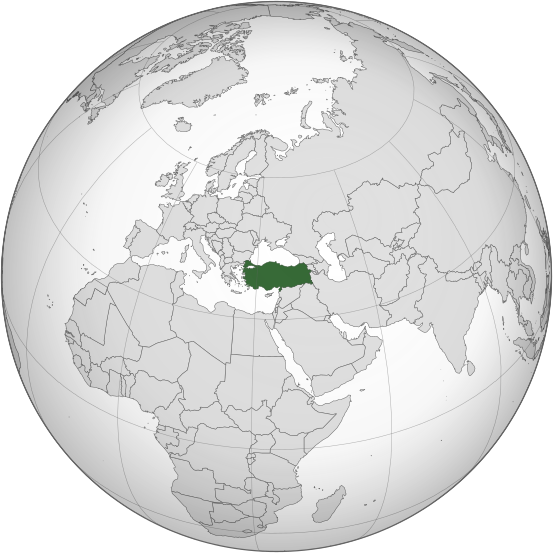
Situated between Europe, Asia, and the Middle East, Türkiye forms a strong axis of connection not only geographically, but also culturally and historically. This position explains not only its place on the map, but also the power of passage, encounter, and interaction it has carried for centuries.


What gives Turkey its strength is not that it stands out for just one thing, but that different dimensions can come together naturally within a single travel experience.
On one side are imperial skylines, the texture of old cities, places of worship, ports and archaeological memory; on the other, coastal towns, an open-air rhythm, sunsets, lightness and a freer way of life.
On one side lie seriousness, history and cultural weight; on the other, shared meals, tea, coffee, walking, scenery and the warmth of everyday life. What makes Turkey memorable is not that each of these elements is powerful on its own, but that they connect to one another naturally.

That is why, within the same country, a visitor can find profound cultural depth, striking scenery, a sociable coastal atmosphere, and the warmth of everyday life that allows for a more personal connection.
Monumental structures, old quarters, ports, places of worship and bazaars do not merely display the past; they also shape the atmosphere of the present.
Coasts, valleys, highlands, lakes and mountain roads genuinely change the rhythm of the journey; they keep the sense of route alive.
Breakfast, tea, Turkish coffee, meze, regional desserts and local dining culture make the country feel more personal, warmer and more memorable.
City, coast, culture, nature, short getaways and longer plans can all be linked naturally within the same country.
What makes Türkiye compelling is not simply that it offers many things; it is that what it offers can come together within the same feeling of travel without conflicting with one another.

The Istanbul–Bursa–Edirne–Konya–Mardin–Şanlıurfa–İzmir–Ephesus line offers extraordinary depth in terms of architecture, faith, trade, urban memory, and civilizational continuity. It is also the core spine that keeps Türkiye from being merely a collection of places to visit.

Antalya, Kaş, Fethiye, Bodrum, Marmaris, Çeşme, and Alaçatı bring together the sea, harbors, coves, sunsets, walking, and an open-air dining culture along the same line.

Breakfast culture, tea, Turkish coffee, meze, kebab, seafood, regional desserts, and local markets leave the taste of the journey not only on the palate, but in memory as well.
The ability to move within a single day from historical gravitas to coastal lightness, from cultural discovery to the warmth of the table, makes the country’s travel experience fuller, more layered, and more memorable.
The historical depth carried by Anatolia sets Turkey apart from an ordinary travel destination. Here, the past remains visible not only in museums, but on the ground, in the streets, in the urban fabric and within the landscape itself.

Ancient cities such as Ephesus carry the architectural and public memory of the classical world, while different centers across Anatolia still make visible the traces of trade, belief, urban life and state continuity. This depth makes Turkey not only beautiful, but meaningful.
This axis shows the visitor not only structures, but also how a country has been layered throughout history and how it continues to live on within today’s cities.

Sites such as Göbeklitepe open onto much earlier phases of human history. This broad span of time makes Turkey’s historical narrative unique.
In Turkey, historical travel is not merely an experience of “old stones.” Here, the visitor also sees how civilizations were layered onto one another and how they left their mark on today’s cities.
That is why, in Turkey, history is not a static field of knowledge, but a living layer that enlarges the meaning of travel.
Domes, minarets, courtyards, stone craftsmanship, historic places of worship, and monumental silhouettes are among the strongest elements that shape Türkiye’s visual memory.
Hagia Sophia, Sultanahmet, Süleymaniye, Selimiye, and historic houses of worship in different cities across Anatolia make visible not only Türkiye’s aesthetic power, but its symbolic power as well. These structures crown cities, provide a sense of direction, and define the atmosphere.
Here, faith and architectural heritage are inseparable from one another. These structures are not merely objects to look at; they are living focal points that carry the city’s memory and historical continuity.

In Türkiye, a strong urban silhouette is often built through historic structures. This turns architectural heritage from a tourist detail into a part of the country’s character.
This section highlights the country’s aesthetic, historical, and symbolic weight all at once. Türkiye’s silhouette remains memorable to a great extent thanks to this heritage.
The four route profiles below show why the country cannot be contained within a single holiday template. Turkey’s strength lies in the natural way these different atmospheres can come together within the same map.

Istanbul is the strongest starting point for feeling Turkey’s cultural weight most intensely. The imperial trace, the Bosphorus line, ferries, neighborhoods, bazaars, and evening atmosphere make this city not merely large, but layered and alive.
Here, history does not remain only in monuments; it blends into the view, the walk, commerce, rhythm, and everyday life. For that reason, Istanbul is one of the strongest gateways to understanding the country’s overall spirit.

Cappadocia is one of Turkey’s most poetic and most distinctive landscape axes. Valleys, rock formations, cave heritage, and the light of the early hours give this place an almost timeless character.
This route reminds us that Turkey is unique not only historically, but also visually, emotionally, and atmospherically. Its ability to carry silence and visual intensity at the same time is what makes Cappadocia special.

The line of Antalya, Kaş, Fethiye, Bodrum, Marmaris, Çeşme, and Alaçatı brings Turkey’s brighter, freer, and more social face to the fore. Here, the sea is not only scenery, but an essential element that sets the tempo of daily life.
Coves, harbors, coastal roads, walks, sunsets, and meals in the open air turn this line into an experience that feels light without being superficial. Turkey’s more relaxed side is seen here in its strongest form.

The Black Sea highlands, lakesides, and slower routes in inland regions also show that Turkey is not only a dense, large, and fast-moving country. Here, travel shifts into a cooler, calmer, and more restorative tone.
Greenery, highlands, lake views, tea culture, and slower-paced stops reveal the country’s side that invites rest and a lower rhythm. This axis adds a breathing depth to Turkey’s map.
The transition from urban weight to coastal lightness, from the silence of landscape to the warmth of everyday life, feels natural. This is where Turkey’s real effect emerges: as a travel space that can answer different moods without losing its wholeness.
What makes a country memorable is sometimes a landscape, sometimes a building, and sometimes a table. In Türkiye, table culture is one of the strongest carriers of the journey’s emotional memory.

Breakfast culture, tea, Turkish coffee, meze, regional desserts, seafood, varieties of kebab, and local markets make Türkiye’s culinary side not only delicious, but also full of character and easy to remember.
These tables often represent the country’s warm side. The people, the rhythm, the sharing, the long sittings, and the intimacy of everyday life turn food into one of the journey’s central experiences.

In Türkiye, breakfast is not merely a morning meal; it is a culture that softens the rhythm, makes the view feel more livable, and adds a human closeness to the journey.
Türkiye stands out not only for what is seen, but also for what is tasted and shared. The warmth of Türkiye is often felt most clearly at the table.
That gives the country strength not only for a particular period, but for different travel intentions throughout the year. The same country can feel open, lively, and social in one season, and calm, layered, and restorative in another.
Spring’s openness, summer’s coastal energy, autumn’s balance, and winter’s inward warmth complete one another on the same map.

It is one of the most balanced times for cultural routes, old towns, highland roads, and Aegean towns. Weather, light, and nature work together; both the country’s historical side and its scenic side can be experienced comfortably at the same time.
Spring is also a strong season for visitors getting to know Turkey for the first time, because before the intensity of summer sets in, many of the country’s faces emerge in a softer and more legible way.
The coasts come fully into their own. Bays, beaches, marinas, summer evenings, and open-air tables bring out Turkey’s freer, lighter, and more outward-facing side.
In summer, the sea is not just scenery; it becomes one of the main forces shaping the flow of daily life, the hours for walking, the rhythm of the evening, and the emotional tone of the journey.
The pace of the journey softens. City trips, scenic drives, and cultural stops feel calmer, quieter, and more meaningful. With the crowds thinning, the atmosphere comes through more distinctly.
Autumn brings out Turkey’s more mature and more refined side; it is an especially strong season for those who want to experience culture, landscape, and local life together.

Mountain stays, city atmosphere, thermal regions, and a slower style of travel reveal a more inward-looking yet powerful side of Turkey. In winter, the country begins to speak less through movement than through depth and character.
This season offers a different way of reading Turkey: through thermal stops, snow landscapes, a more composed city experience, and the warm sense of life gathered indoors. It is not as outward-facing as summer, but it can feel more personal and more memorable.
This country is not merely a summer coast destination or a country of history-focused travel. As the seasons change, Turkey changes its tone as well; yet the sense of richness it offers remains constant. That is exactly why it is not a one-visit country, but a place that makes you want to return.
The Aegean and Mediterranean coasts, bays, harbor towns, sunset, open-air dining, and the everyday bond formed with the sea make Türkiye’s appeal in the summer months more distinct.
The Antalya, Kaş, Fethiye, Bodrum, Marmaris, Çeşme, and Alaçatı line presents a brighter, freer, and more open-air-oriented Türkiye. In the summer months, the country’s rhythm moves outdoors; the sea, the coastal road, the sunset, and the table become a whole.
For this reason, a summer holiday in Türkiye is not just a beach experience; it is a fuller way of traveling in which scenery, social life, harbor atmosphere, lightness, and life energy come together.
In Türkiye, summer is not lived only in daylight. The open-air flow that begins with sunset brings together walking, scenery, and the table within the same summer memory.
This section shows how the coastline amplifies the feeling of holiday and why Türkiye gains a brighter, more social, and more memorable character in the summer months.
Snowy scenery, mountain atmosphere, city lights, thermal retreats, and the warm feeling of life gathered indoors also turn Turkey’s winter months into a compelling season for travel.
Mountain stays, snowy scenery, thermal regions, a calmer city experience, and a slower travel rhythm make Turkey’s winter side far more intimate and far more distinctive.
It is not as outward-looking as summer; yet it can often be more memorable. Because in this season, the country works less through spectacle than through feeling: cool air, warm interiors, a more measured pace, and a more enveloping atmosphere.

Here, a winter holiday is not just about sport; it is also about rest, retreat, and renewal. That makes Turkey’s winter side richer and longer-lasting in memory.
In Turkey, you can feel very clearly how mountain atmosphere, thermal comfort, city evenings, and a slower rhythm come together to create a powerful winter experience.
The fact that a journey stretching from major cities to coastal towns, and from cultural routes to slower escape points, remains manageable turns Türkiye into not only an impressive destination, but also a practical one.
Modern airports, domestic connections, a clear sense of orientation, and smooth transitions between regions make the country’s large scale more accessible and more manageable.

Large airports, a domestic flight network, and a modern terminal setup show from the very first moment that the country is not only appealing, but also accessible and practical as a destination. That, in turn, creates a sense of confidence right at the start of the journey.
Here, comfort does not mean luxury alone. Its real strength lies in being able to keep moving without losing direction even as the country expands before you, and in preserving a sense of flow when shifting from city to coast or from a cultural route to quieter stops.

In Türkiye, strong gateways do not simply make arrival easier; they also make it more feasible to combine different sides of the country within a single holiday. This allows for a travel plan that feels freer, yet more controlled.
The country is not only beautiful; it also creates a travel experience that feels fluid, clear, and manageable. That turns Türkiye into a destination that feels comfortable and reassuring not only for first-time visitors, but also for those who return.


City, coast, landscape, table, comfort, and calm can all find a place within the same journey in this country without disturbing one another.
As the journey unfolds, the tone changes, but the identity does not break apart. Because the memory of the big city, the spaciousness of the open coast, personal moments, and restorative stops can connect within the same country, Turkey often remains not merely as a place that has been visited, but as an experience one would want to build again.
What makes Turkey impressive is not a single image, but the way different scales and different emotions can naturally come together within the same route.
The Republic of Turkey is not a country that can be summed up in just a few photographs.

The city’s scale feels grand, yet at the same time a closeness on a human scale is also felt.

When the landscape draws closer to a personal rhythm, its effect in memory remains stronger and more intimate.

When the rhythm of the coast and the feeling of the table come together, the country’s warmer and more communal side becomes more visible.

Water, silence, and landscape show that Turkey can be not only lively, but also restful.

The open horizon and the line of the sea reveal the country’s open, breathable side.

When the lines of sea and mountain work together, even the lighter side remains strong.
A single photographic frame is never enough to define Turkey. Even bringing together the places worth seeing in Turkey through visual illustrations is often not enough. The Republic of Turkey is a country with a deep historical past, set across a geography too vast to be summarized through photographs.


What stays behind is often not a single photograph, but a series of strong moments connected to one another. When city, coast, table, calm, and the feeling of transition settle into the same memory, the result becomes more powerful.

Operating by Mark Turizm with License Number: 65948-5 / 0612072050600010 / Document
Verification Link: https://etbis.ticaret.gov.tr/tr/SiteSorgulamaSonuc?siteId=de5aa31a-96f8-4184-8d4a-93991b3c092c
This website belongs to a commercial enterprise operating within the scope of the consultancy service specified in the service contract at the bottom of each page
